IRS Releases Adjusted Contribution Limits for FSAs and Commuter Accounts
IRS Releases Adjusted Contribution Limits for FSAs and Commuter Accounts

On October 9th, the IRS released the 2026 maximum contribution limits for Flexible Spending Arrangements (FSA) and commuter accounts. Rev. Proc. 2025-32 provides the inflation-adjusted items for 2026 for various code provisions.  

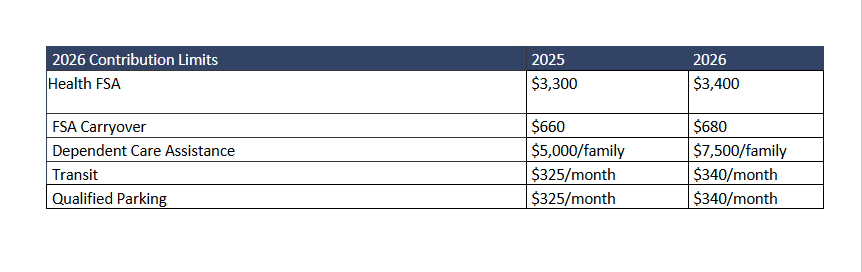
For taxable years beginning in 2026, the annual contribution limit for health FSAs has increased from $3,300 in 2025 to $3,400. Additionally, the maximum carryover amount has also increased from $660 in 2025 to $680. The permissibility of carrying over unused FSA funds is dependent on the language of the cafeteria plan. 

The maximum contribution amount for dependent care assistance plans increased from $5,000 in 2025 to $7,500. Employers increasing the amount employees can contribute to their dependent care assistance plan should be mindful of the nondiscrimination testing implications under IRC Section 129.  

Finally, for taxable years beginning in 2026, the monthly limitation for transportation fringe benefits (e.g., commuter highway vehicle, transit pass, and qualified parking) increased from $325 in 2025 to $340.

Click Here to view the chart!

Most Recent Media

  • RxDC Reporting Due June 1, 2026 

    RxDC Reporting Due June 1, 2026 

    The Centers for Medicare and Medicaid Services (CMS) has updated the Prescription Drug Data Collection (RxDC) resources. The updates include changes to the RxDC Reporting Instructions and new RxDC templates and data dictionary.  As a reminder, the RxDC reporting was established as part of the transparency rules under the Consolidated Appropriations Act 2021 (CAA). RxDC requires employer-sponsored health plans and insurance issuers to...

    Read More
  • Qualified Plan Non-Discrimination Testing: Protecting Compliance, Fairness, and Fiduciary Responsibility

    Qualified Plan Non-Discrimination Testing: Protecting Compliance, Fairness, and Fiduciary Responsibility

    Qualified Plan Non-Discrimination Testing: What Employers Need to Know Retirement plans are one of the most valuable benefits employers offer, but they also carry significant regulatory responsibility. Each year, qualified retirement plans must undergo Non-Discrimination Testing (NDT) to ensure the plan does not disproportionately benefit Highly Compensated Employees (HCEs) over...

    Read More
  • Fiduciary Liability Lawsuits Target Employers, Brokers, and Plan Fiduciaries

    Fiduciary Liability Lawsuits Target Employers, Brokers, and Plan Fiduciaries

    New Lawsuits Focus on Fiduciary Duties for Voluntary Benefits Feb. 9, 2026 Schlichter Bogard LLC, a law firm well-known for filing lawsuits against retirement plan fiduciaries (and recently health and welfare plan fiduciaries), filed separate class action lawsuits against four employers, their employee benefit plan fiduciaries, and their employee benefit...

    Read More

Check Out Our Videos

A patient lies on an examination table beside a modern MRI machine while a medical professional reviews notes.
Image featuring the text What Clients Say About Innovative over a blurred background of a meeting, highlighting client testimonials.
Text overlay promoting a video on diabetes management and prevention, featuring a doctor and patient in a clinical setting.
  • RECERTIFICATION PROVIDER HRCI
  • Best of the Biz
  • 2024 Top-rated Employee Benefits
  • BCCC Business Excellence
  • SHRM RECERTIFICATION PROVIDER
  • Certified WBENC
  • CENTRE FOR FIDUCIARY EXCELLENCE
  • SOC TYPE
  • UBA Partner Firm
  • RECERTIFICATION PROVIDER HRCI
  • Best of the Biz
  • 2024 Top-rated Employee Benefits
  • BCCC Business Excellence
  • SHRM RECERTIFICATION PROVIDER
  • Certified WBENC
  • CENTRE FOR FIDUCIARY EXCELLENCE
  • SOC TYPE
  • UBA Partner Firm